Reviewing the Mug Wrap Horse Embroidery Design
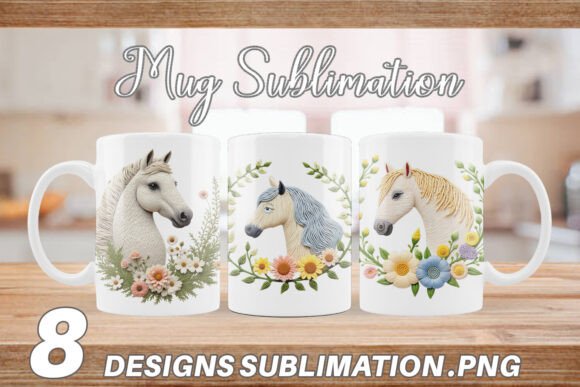
As a designer who spends half my life staring at digitized files and the other half watching needles punch through fabric, I have learned to be skeptical of generic assets. We often see bundles labeled as Illustrations or Graphics that look stunning on a screen but fall apart under the mechanical stress of an embroidery machine. Today, I am taking a close, practical look at the Mug Wrap Horse Embroidery asset to determine if it holds up in real-world production.
It is important to address the source material immediately. The product description identifies this as part of a "Mugs - Coffee Mugs Sublimation Pack" containing unique PNG files. For an embroiderer, this raises an immediate red flag. PNGs are raster images, not vector-based embroidery files like DST or PES. This means the Mug Wrap Horse Embroidery concept is likely a visual motif intended for sublimation printing, which we must then manually digitize or trace if we want to stitch it. This review assumes you are either using a pre-digitized version derived from this graphic or planning to convert this high-resolution illustration into a stitch file yourself.
First Impressions and Visual Mood
The horse motif is timeless, but its execution determines its marketability. In this specific design, the lines suggest a blend of rustic charm and modern minimalism. The mood is calm and grounded, making it ideal for home decor or casual apparel rather than high-energy sports gear. When I visualize this as a machine embroidery design, I see potential for clean satin stitches outlining the mane and fill stitches for the body. However, because the original asset is a sublimation graphic, the detail level might be too fine for standard thread counts. We need to simplify complex gradients into solid color blocks to ensure stitching clarity.
Real-World Application: The Custom Tote Bag Test
To test the viability of this design, I imagined a recent client request: a set of reusable grocery totes for a local equestrian club. They wanted something durable, stylish, and recognizable from a distance. Using the Mug Wrap Horse Embroidery silhouette as a base, I mapped out how it would sit on a canvas tote bag design.
On a textured canvas, thin running stitches disappear. Therefore, this design would require a robust approach. I would recommend using a dense fill stitch for the main body of the horse to ensure it pops against the weave of the fabric. If the original graphic includes intricate details like individual hairs or subtle shading, these must be omitted or converted into texture patterns. A finished product that looks muddy due to excessive tiny stitches will not sell. For this project, the design’s strong outline allows it to scale well, maintaining its integrity even when enlarged to fit a 5x7 hoop.
Versatility Across Product Lines
Beyond totes, where else does this motif work? I see strong potential in several areas for Etsy sellers and craft business owners:
- Sweatshirt embroidery: Placed on the left chest, a simplified version of this horse creates a boutique feel. It avoids the bulkiness of large back prints while still offering brand recognition.
- Baby embroidery: Soft pastels and a smaller scale make this suitable for onesies or nursery blankets. However, you must reduce stitch density significantly to prevent the fabric from puckering.
- Embroidered patch: This is perhaps the best use case. By stitching the design onto twill with a merrowed edge, you create a versatile accessory that can be ironed onto jackets or hats. This bypasses the issue of stabilizing difficult fabrics directly.
- Holiday embroidery: With minor tweaks, such as adding a wreath or seasonal colors, this graphic can become a bestseller during the winter gift season.
Technical Challenges and Fabric Considerations
While the aesthetic is appealing, the transition from a sublimation PNG to a stitched item presents hurdles. If you are digitizing this yourself, pay close attention to stitch density. Sublimation prints can handle infinite detail; embroidery cannot. Over-digitizing leads to thread breaks and needle deflection.
Consider the fabric texture. On smooth cotton, satin stitches look crisp. On fuzzy fleece or terry cloth, those same stitches sink in. For a sweatshirt embroidery project, you might need to use a topping stabilizer to keep the threads visible. Additionally, if you are applying this to dark fabric, ensure your thread colors have enough contrast. A dark brown horse on a navy shirt will vanish. Always test your color palette in black and white mockups first to check value contrast.
Curved surfaces like caps require special caution. The Mug Wrap Horse Embroidery layout might be too wide for a standard cap front panel without distortion. You may need to split the design or reduce its width significantly to accommodate the curve without causing gaps in the stitching.
Commercial Viability and Licensing
For commercial embroidery professionals, the source of your design assets matters. Since this originates from a sublimation pack, you must verify the license terms. Does the creator allow you to use the PNG as a reference for creating a new embroidery file? Can you sell the finished stitched items? Never assume. Always read the fine print before listing products on your small shop product page.
If the license permits commercial use of derived works, this design offers good value. It is distinct enough to stand out in a crowded marketplace but simple enough to produce quickly. Quick production time equals higher profit margins for handmade product sellers.
Practical Designer Notes
Before you commit to a full production run, follow these steps:
- Test on scrap fabric: Never stitch directly on your final garment. Use the same fabric type and weight to check for puckering.
- Check hoop size: Ensure the design fits within your machine’s maximum area. If the original graphic is wide, you may need a larger hoop or a redesign.
- Inspect small details: Zoom in on the digitized file. Are there tiny jumps or unnecessary trims? Clean up the pathing to reduce thread waste.
- Use proper stabilizer: Match the stabilizer to the fabric. Cut-away for stretchy knits, tear-away for stable wovens.
- Compare light and dark backgrounds: Verify that your chosen thread colors work on both white and black garments if you plan to offer multiple options.
In conclusion, the Mug Wrap Horse Embroidery motif has strong potential as a versatile design asset for makers. While its origin as a sublimation graphic requires careful digitization and adaptation, its clean lines and emotional appeal make it a worthy candidate for custom apparel and home goods. With thoughtful technical adjustments and respect for material limitations, this design can elevate your embroidery project from amateur to professional grade.